
How to Use AI for Career Transitions in 2026
- Nov 19, 2026
- Artificial Intelligence
How to Use AI for Career Transitions in 2026
Discover how any professional (including students & working professionals) can use AI to explore career options, identify skill gaps and prepare for new opportunities.
Moving from marketing to product management, finance to consulting, or operations to business analytics can be challenging. You may have relevant experience but not know which skills transfer or what you need to learn.
AI can make this process more structured.
AI can help you plan a career transition by identifying transferable skills, analysing job requirements, highlighting skill gaps and suggesting practical projects. However, the real advantage comes from combining AI capabilities with your existing experience and professional judgement.
With our experience of mentoring more than 30000+ students and working professionals, any tool including AI will only help when you have clarity of your target which comes from exploration and talking to people or mentors and a deep honest reflection of your interest, motivations and capabilities. An AI can help you give more ideas, data, structure and tools to think about your own profile.
How Is AI Changing Career Development?
AI is increasingly becoming a tool for professional learning and career development.
According to Deloitte’s 2026 Gen Z and Millennial Survey – India report, 93% of Gen Z respondents in India use AI in their day-to-day work.
Professionals are increasingly using AI to explore career options, learn new skills, seek career guidance and manage work-related challenges.
For career development, AI can help you:
- Explore potential career paths.
- Identify transferable skills.
- Analyse job descriptions and skill requirements.
- Develop personalised learning plans.
- Practise interviews and build practical projects.
- Last but not the least, a very important use case of AI I suggest is that they should use AI to get more practical examples of their target career, stories about how people have transitioned previously, case studies which will help them to learn about their target career. Idea is that they should develop a sense of understanding on what are the different practical elements of the target career and how things will look when they join there.
However, what needs to be kept in mind that access to AI does not automatically translate into career growth. What matters is how effectively you apply it.
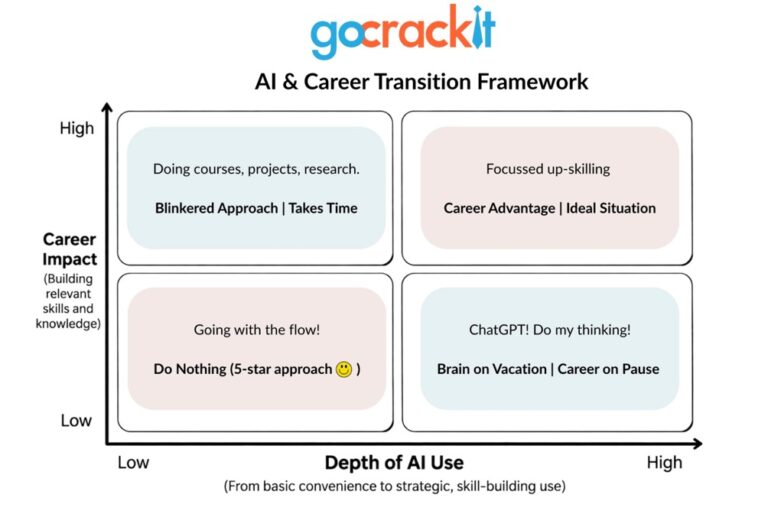
So how are using AI for your career? You can identify which stage are you in with below framework.
How Can You Use AI to Transition into a New Career?
You do not necessarily need to start from scratch when changing careers. Many skills transfer across roles and industries.
Consider these examples:
Current role | Target career | Transferable skills |
Marketing | Product Management | Customer insights, market research, GTM |
Finance | Consulting | Financial analysis, modelling, problem-solving |
Operations | Business Analytics | Process optimisation, KPI tracking |
Sales | Product Management | Customer understanding, stakeholder management |
AI can help you identify these transferable skills and understand what additional capabilities you need.
1. Identify your transferable skills
Share your resume and target job description with an AI tool to understand how your existing experience aligns with the new role.
Example prompt:
“I have three years of marketing experience and want to transition into product management. Identify my transferable skills, highlight my five most important skill gaps and suggest practical projects to demonstrate my readiness.”
Once you are ready with above give another prompt “Tell me some practical examples of product management practices which became success or failure and how a product manager could have impacted that.”
The above will give you some practical knowledge.
At the last you can ask AI to practice with you mock interviews around your resume, behavioural, situation & case study questions specific to your profile and aspirations.
2. Analyse job descriptions and identify skill gaps
Job titles alone do not explain what employers expect. Analyse multiple job descriptions to identify recurring skills, tools and responsibilities.
For example, someone transitioning into product management may need to develop:
- Product strategy and prioritisation.
- SQL and product analytics.
- User research.
- Agile methodology.
- Stakeholder management.
- Also ask AI to create the JD into a practical story so that you can understand all the requirement with an example.
AI can help compare your existing capabilities against these requirements and prioritise what you should learn.
You can use following prompt:
I am exploring a career transition and want to understand the skills required for my target role.
Analyse the following job description(s) against my resume:
Job Description(s): [Paste the JDs here]
My Resume: [Paste your resume here]
Identify:
- The key skills, responsibilities, and competencies common across the job descriptions.
- My strengths and relevant experience that align with these requirements.
- My skill gaps, categorised as Strong, Developing, or Gap.
- The top 5 skills I should prioritise developing, ranked by importance.
- For each priority skill, explain how it is applied in a real workplace scenario. Create a realistic example of how I could demonstrate this skill, including the business problem, my role, actions, challenges, and measurable outcome.
Keep the analysis practical, specific to my profile, and focused on helping me prepare for the target role. Avoid generic career advice.
3. Build practical projects using AI
Learning concepts is important, but demonstrating your ability to apply them makes your profile more credible.
Target career | Suggested project |
Product Management | Identify a customer problem and propose a product solution |
Business Analytics | Analyse sales data and recommend revenue improvements |
Consulting | Develop a market-entry strategy for a company |
Finance | Build a company valuation model |
Marketing | Develop a customer segmentation strategy |
Use AI to support research, analysis and problem-solving, but ensure you understand and can explain your work independently.
You can use the following prompt to get the projects:
I want to build a practical, portfolio-ready project aligned with my target career.
Target Career: [Enter your target role]
My Background: [Paste your resume or briefly describe your experience]
Suggest a realistic business problem that I can solve through a hands-on project. Then guide me step by step to:
- Define the problem, target users, and project objective.
- Identify the data, tools, and resources required.
- Use AI to support research, analysis, and problem-solving.
- Build a practical solution with clear deliverables.
- Measure the impact using relevant business metrics.
- Document the project as a portfolio case study that I can showcase on my resume and LinkedIn.
- Prepare to explain my approach, decisions, challenges, and learnings in an interview.
Make the project appropriate for my experience level, focused on real-world application, and achievable within 1–2 weeks. Avoid generic or purely theoretical projects. Help me understand the work rather than simply generating the final output for me.
Using AI: Passive Learning vs Practical Application
There is a difference between using AI to complete tasks and using it to develop professional capabilities.
Passive use of AI | Practical application |
Generate a resume | Analyse gaps against job requirements |
Complete random courses | Follow a targeted learning plan |
Collect certificates | Build relevant projects |
Generate interview answers | Practise and improve your reasoning |
Ask AI to solve problems | Use AI to challenge your assumptions |
The second approach helps you build evidence of capability, not just familiarity with AI tools.
What Skills Should You Develop in the Age of AI?
Professionals need a combination of AI-related capabilities and human skills.
AI and technical capabilities | Human and professional skills |
AI literacy | Critical thinking |
Data literacy | Communication |
Digital adaptability | Problem-solving |
Automation awareness | Creativity |
Domain knowledge | Stakeholder management |
AI can support research and analysis, but professionals still need to exercise judgement, understand business context and take responsibility for decisions.
What Does 2026 Research Tell Us About the Future of Work?
The World Economic Forum’s June 2026 report, Artificial Intelligence and the Future of Entry-Level Work, highlights that more than one in three young workers globally are employed in occupations with medium to high exposure to AI-driven task change.
For students and fresh graduates, this makes practical experience and continuous learning increasingly important.
For experienced professionals, the opportunity lies in combining existing industry knowledge with new AI capabilities.
Your 30-Day AI-Powered Career Transition Plan
If you are considering a career change, start with a structured 30-day plan.
Timeline | Action | Expected outcome |
Week 1: Explore | Shortlist two roles and analyse job descriptions | Career clarity |
Week 2: Assess | Identify transferable skills and gaps | Learning priorities |
Week 3: Build | Complete one practical project | Evidence of capabilities |
Week 4: Demonstrate | Update your resume, practise interviews and seek feedback | Stronger career profile |
You may not be ready for every opportunity in 30 days, but you will have greater clarity, a focused learning plan and tangible evidence of progress.
How Can Career Mentoring Help with a Career Transition?
If everyone uses AI who will shine in the competition? While AI can help you explore career options and accelerate learning. However, guidance from professionals with relevant industry experience can help you validate your choices and understand actual employer expectations.
A career mentor can help you:
- Validate your target career.
- Identify relevant transferable skills.
- Prioritise skill development.
- Improve your resume and project portfolio.
- Prepare for role-specific interviews.
At GoCrackIt, personalised career mentoring helps students and working professionals navigate career decisions, prepare for opportunities and build stronger professional profiles.
Explore our mentors – https://gocrackit.com/
Idea is that combining AI-assisted learning with experienced professional guidance can make your career transition more structured and focused.
The Real Career Advantage Is Not AI Alone
AI tools will continue to evolve. The more durable advantage is the ability to learn quickly, adapt your skills, understand business problems and use technology responsibly.
For Gen Z, the opportunity is to become better at thinking, learning and working with AI, not simply better at prompting it.
For professionals considering a career transition, you do not necessarily need to start over. Understand what you already bring to the table, identify what your next role demands and build a credible bridge between the two.
Your next career move could begin with a better question, a focused learning plan and one practical step towards the professional you want to become.
Get More Insights

How to Use AI for Career Transitions in 2026
Discover how AI can simplify career transitions in 2026 through skill development, resume optimisation, job searches, and interview preparation.
Read More
Mastering Risk Management: A Guide for MBA Students and Professionals
A practical guide to mastering risk management for MBA students and professionals in business and finance.
Read More
Leveraging Structured Thinking in Career Transitions
Use structured thinking to navigate career transitions with clarity, confidence, and actionable steps.
Read MoreQUICK LINKS
- Home
- About
- Career Conversations
- Resume Reviews
- Mock Interviews
POLICIES
- Terms & Conditions
- Privacy Policy
- Refund Policy
CONTACT
- +91-81485-89887
- support@gocrackit.com
- #518, Ground Floor, 10th Cross, Mico Layout, BTM 2nd Stage, Bangalore - 560076