
Will AI replace MBA Jobs? Which roles are actually at risk?
- Oct 13, 2026
- Artificial Intelligence
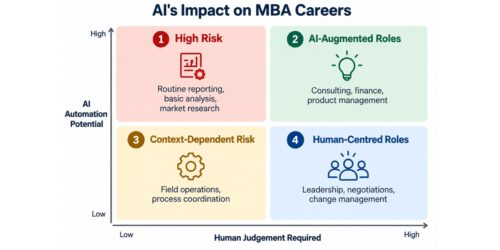
For years, an MBA has been a gateway to careers in consulting, finance, marketing, product management, operations and strategy.
But AI is changing the nature of these jobs.
If AI can analyse data, build financial models, create presentations, research markets, write reports and generate recommendations, a natural question emerges:
Will AI replace MBA jobs?
The short answer is: some will change, some will shrink, and a few may disappear but AI is unlikely to replace MBA careers altogether.
The bigger change will be in what MBA professionals are expected to do.
AI Will Replace Tasks Before It Replaces Jobs.
The most important distinction is between a job and the tasks within that job.
Take a management consultant. A consultant may spend hours researching competitors, analysing spreadsheets, creating charts, preparing presentations and summarising interviews.
AI can increasingly perform or accelerate many of these activities.
But the consultant still needs to answer:
- What is the real business problem?
- Which question should we solve first?
- Are the assumptions reasonable?
- What does the analysis actually mean?
- What should the client do?
- How do we convince stakeholders to act?
These require judgement, context, communication and accountability.
That is why the future is less likely to be Human vs. AI and more likely to be Human + AI.
Which MBA Roles Are Most at Risk?
The greatest risk is not necessarily associated with an entire profession. It is associated with roles where a large proportion of the work is repetitive, predictable and data-intensive.
A. MBA Jobs at Risk:
There are higher AI exposure to following roles :
- Junior Business Analysts
Data collection, reporting, dashboard preparation and basic analysis can increasingly be automated.
- Market Research
AI can rapidly search, synthesise and compare large volumes of market and competitor information.
- Financial Reporting and MIS
Automated dashboards and reporting tools can significantly reduce manual reporting work.
- Basic FP&A
Forecasting, variance analysis, scenario generation and routine reporting are increasingly AI-assisted.
- Junior Consulting Roles
Research, benchmarking, data analysis and presentation creation are areas where AI can dramatically improve productivity.
- Basic Digital Marketing
Content creation, campaign analysis, customer segmentation and optimisation can increasingly be automated.
This doesn’t necessarily mean these jobs disappear.
It means fewer people may be required to perform the same amount of work.
B. How different MBA roles will get impacted by AI:
The following is analysis of how different careers will get impacted:
Consulting – Consulting Could See One of the Biggest Changes
Traditionally, a project might look like:
Research → Analyse → Build Excel → Create Charts → Build Slides → Present Recommendations
AI can increasingly support the first five steps.
This could change the traditional consulting pyramid.
Instead of a senior consultant requiring a large team of analysts, the same consultant may eventually work with a much smaller team equipped with AI tools.
This doesn’t make consulting less important.
It makes higher-order consulting skills more valuable.
The future consultant will need to be better at:
- Problem definition
- Hypothesis-driven thinking
- Strategic judgement
- Client communication
- Stakeholder management
- AI-enabled analysis
- Turning insights into decisions
The question will shift from:
“Can you analyse this data?”
to:
“Can you identify the right problem, use AI to analyse it, challenge the output and turn it into a business decision?”
Finance: Financial analysis will Be automated, Accountability Won’t
Finance is another area where AI can significantly change work.
AI can assist with:
- Forecasting
- Financial modelling
- Variance analysis
- Research
- Risk analysis
- Scenario modelling
- Report generation
But someone still needs to decide:
- Should we invest?
- How much risk should we take?
- Should we acquire this company?
- Are these assumptions realistic?
- How should management respond?
This creates an important distinction.
- Routine financial reporting → High exposure
- Basic financial analysis → High exposure
- Strategic finance → Lower exposure
- M&A and investment decisions → Lower exposure
- Financial leadership → Much lower exposure
The closer a role is to judgement, capital allocation and accountability, the harder it is to automate completely.
Marketing: Content Is More Exposed Than Strategy
Marketing is already experiencing significant AI disruption.
AI can create:
- Ad copy
- Social media content
- Emails
- Product descriptions
- Campaign variations
- Customer insights
* Marketing reports
This means marketers whose primary value is content execution face greater pressure.
But marketing is much more than content.
Someone still needs to determine:
- Who is the customer?
- Why will they buy?
- What should the brand stand for?
- How should the company position itself?
- Which market should we enter?
Strategic thinking, consumer understanding and creativity therefore remain valuable.
Product Management May Actually Become More Valuable
Product Management – It may seem highly exposed to AI. AI can write PRDs, analyse user feedback, generate product ideas, create prototypes and analyse product metrics. But product management is fundamentally about making choices:
- What problem should we solve?
- For whom?
- Why now?
- What should we build?
- What shouldn’t we build?
- How will it create business value?
- And how do we align engineering, design, sales, marketing and leadership?
AI may reduce the administrative workload of product managers while increasing the value of product judgement and strategic thinking.
The Product Manager of the future may spend less time writing requirements and more time orchestrating AI-enabled teams and making better decisions.
C. Risk of AI on MBA jobs
The Biggest Risk May Be the Junior Layer. This could be the most important implication for MBA students.
The biggest disruption may not be:
“AI replaces senior executives.”
It may be:
“AI reduces the amount of junior work available.”
A consultant who previously needed five analysts may eventually need two.
A finance manager who had a team preparing reports may need fewer people.
A product manager may use AI to perform work previously handled by analysts and researchers.
This creates a difficult question:
If AI reduces entry-level work, how will young professionals gain experience?
Historically, professionals developed expertise by doing repetitive tasks first and gradually moving toward higher-value work. AI may compress that journey.
Therefore, MBA students may need to develop higher-value skills much earlier in their careers.
What Skills Will Become More Valuable? The traditional MBA toolkit was:
Finance + Marketing + Strategy + Operations + Leadership
The emerging toolkit is:
Business Fundamentals + AI Fluency + Data + Strategic Thinking + Communication + Leadership
You don’t necessarily need to become an AI engineer.
But you should understand:
- What AI can and cannot do
- How to identify AI use cases
- How to work with data
- How to evaluate AI outputs
- How AI changes business models
- How to automate workflows
- How to measure AI ROI
- How to lead AI-driven transformation
The competitive advantage will come from combining business understanding with technology fluency.
D. Conclusion
So, Will AI Replace MBA Jobs?
Some roles will shrink.
Some tasks will disappear.
Some jobs will be redesigned.
And entirely new roles will emerge.
But the biggest career shift may be this:
AI won’t replace every MBA. But MBAs who know how to use AI may increasingly replace those who don’t.
Get More Insights

Will AI replace MBA Jobs? Which roles are actually at risk?
Discover how AI is reshaping MBA careers, which roles face automation, and what skills professionals need to stay ahead.
Read More
Mastering Risk Management: A Guide for MBA Students and Professionals
A practical guide to mastering risk management for MBA students and professionals in business and finance.
Read More
Leveraging Structured Thinking in Career Transitions
Use structured thinking to navigate career transitions with clarity, confidence, and actionable steps.
Read MoreQUICK LINKS
- Home
- About
- Career Conversations
- Resume Reviews
- Mock Interviews
POLICIES
- Terms & Conditions
- Privacy Policy
- Refund Policy
CONTACT
- +91-81485-89887
- support@gocrackit.com
- #518, Ground Floor, 10th Cross, Mico Layout, BTM 2nd Stage, Bangalore - 560076